The Autonomous Engineering Era
The Autonomous Engineering Era
The Autonomous Engineering Era
The Autonomous Engineering Era
The Autonomous Engineering Era
The Autonomous Engineering Era
The Autonomous Engineering Era
The Autonomous Engineering Era
A deep dive into Google Antigravity via Gemini Enterprise, covering agent orchestration, enterprise use cases, verification, security, deployment, and Quadra Systems’ services.
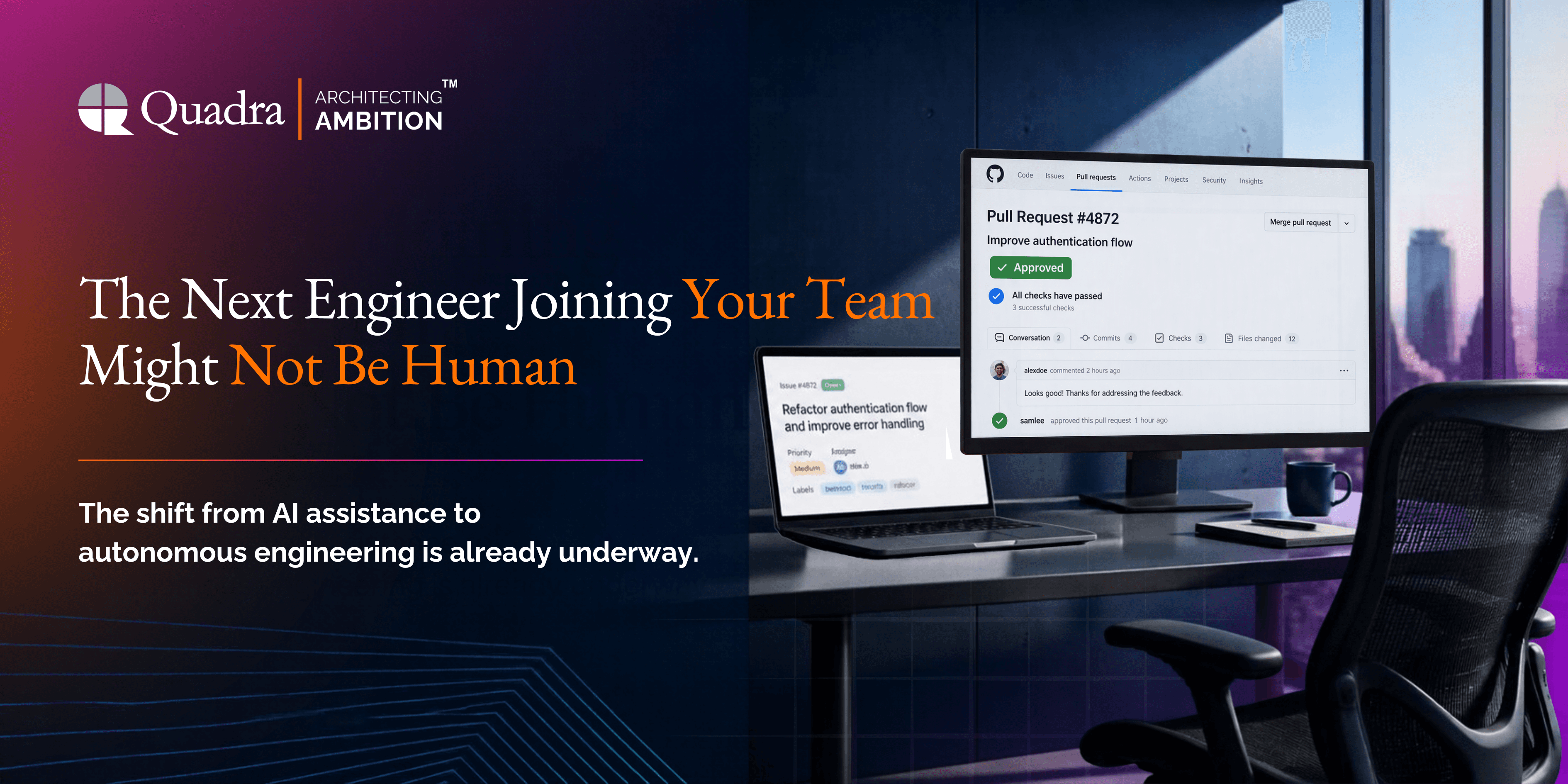
Imagine an engineer assigned a critical bug report at 4:30 PM. Instead of manually digging through legacy code, writing patches, running builds, and testing viewports, an AI agent takes the ticket, fixes the backend bug, executes the test suite, captures video proof in a browser, and submits a green pull request for approval.
This is not a future concept—it is the reality of the Autonomous Engineering Era. We are witnessing a fundamental shift: moving from AI that reacts to AI that acts.
Google Antigravity transforms software delivery by advancing beyond simple inline code completion and basic chat prompts. Powered by Latest Gemini Flash Models—delivering up to 12x faster execution speeds and benchmark-leading performance on complex tasks—Antigravity’s agents plan complex tasks, write code, execute builds and test suites in the terminal, and visually verify UI outcomes in a browser—handing back fully validated, auditable results to your engineering team.
That capability introduces critical architectural and operational choices for enterprise leadership: Where does the agent run, how is it contained, and how is it licensed?
Google Antigravity is built to be Enterprise Ready, featuring built-in security guardrails, workspace sandboxing, lifecycle policy hooks, and full integration with your existing Google Cloud environment. Access is flexible across select Gemini Enterprise app subscriptions and the Gemini Enterprise Agent Platform API with consumption-based pricing.
In this deep dive, we examine Antigravity’s core capabilities, real-world high-ROI use cases, architectural advantages, and the security controls that make agentic automation adoptable at scale.
Google Antigravity expands into a complete ecosystem powered by a shared agent harness co-trained with Gemini models. Within a single task, the platform operates seamlessly across four primary surfaces:
Platform Surface | Description |
|---|---|
Antigravity 2.0 Desktop | A standalone application that acts as a central hub for agent interaction and multi-agent management. |
Antigravity CLI | A high-velocity command-line surface designed for terminal-first developers and scripting. |
Antigravity SDK | Programmatic access to the Antigravity agent harness, enabling custom agent behaviors hosted on your infrastructure of choice. |
Editor Surface | Integrates directly into IDEs for code editing, architecture planning, and file updates. |
Across these surfaces, agents coordinate across three operational loops:
Editor: Plans, structures, and writes multi-file code changes.
Terminal: Executes build scripts, linting, and automated test suites via Gemini 3.5 Flash.
Browser: Drives live UI testing via a subagent integrated with Chrome DevTools through the Model Context Protocol (MCP), generating screen recordings and visual proof.
The primary agent programmatically spawns subagents in specialized, cloned, or dynamically defined roles. Subagents inherit only the parent’s explicitly configured tools and permissions—delegation is strictly non-escalating. For complex initiatives, Agent Teams can be orchestrated asynchronously across isolated Git worktrees, allowing parallel execution without branch conflicts or dirty workspace states.
Category | Details |
|---|---|
The Problem | Software engineering teams lose hundreds of hours onboarding developers to legacy systems or complex microservice architectures. Stale README files and undocumented extension patterns force senior architects to spend hours delivering repetitive walkthroughs. |
The Antigravity Workflow |
|
Business ROI | 75% reduction in developer onboarding time, turning days of manual architecture reviews into a 10-minute automated overview. |
Category | Details |
|---|---|
The Problem | A critical checkout error breaks during peak promotion hours. Reproducing, fixing, and verifying the bug across multiple mobile viewports consumes hours of engineering capacity. |
The Antigravity Workflow |
|
Business ROI | 80% drop in Mean Time to Resolution (MTTR)—slashing bug resolution from 4 hours to under 20 minutes while providing visual proof to QA and CAB stakeholders. |
Category | Details |
|---|---|
The Problem | Upgrading a mandatory security dependency across 12 microservices requires 12 separate repository setups, manual context switching, running 12 test suites, and opening 12 pull requests. |
The Antigravity Workflow |
|
Business ROI | 90% reduction in developer labor hours, turning a week-long maintenance chore into a 30-minute background job. |
Cron-style triggers launch agents autonomously against defined prompts and repositories without human invocation—converting recurring engineering maintenance into reliable background jobs. In addition, JSON Lifecycle Hooks allow security teams to enforce policy-as-code at critical execution milestones (e.g., pre-command execution, post-file modification, or pre-PR creation):
Pull Request Pre-Review: Analyzes open PRs against internal coding standards, flagging missing test coverage or unhandled exceptions before human review.
Nightly Vulnerability Sweeps: Scans dependency manifests for active CVE advisories, submitting contextual code patches rather than raw alert dumps.
Secret & Credential Scans: Continuously scans source code and configuration files for exposed API keys, credentials, and connection strings via pre-commit lifecycle hooks.
Dependency Hygiene & Modern Web Guidance: Upgrades minor dependencies weekly, validates against web best practices, and submits ready-to-test change sets.
Documentation Sync: Reconciles API implementations against developer documentation, flagging out-of-date sections.
Every agent run produces structured deliverables designed to fit seamlessly into corporate Change Advisory Board (CAB) and compliance processes:
Artefact | Description | Business & Compliance Value |
|---|---|---|
Implementation Plan | Steerable, human-reviewable roadmap generated before file modifications. | Eliminates rogue code changes and misaligned requirements. |
Code Diffs | Standard Git line-level changes with explicit approval gates. | Preserves standard code-review and PR workflows. |
Execution Walkthrough | Narrative summary detailing what changed and why. | Accelerates documentation and team knowledge sharing. |
Visual Evidence | Screen recordings and screenshots of end-to-end UI verification. | Provides verifiable proof for audit, QA, and regulatory compliance. |
Conventional developer tools operate in narrow silos:
Isolated AI Editors: Possess file context but lack execution and verification capabilities.
Chat-Based CLI Wrappers: Have terminal access but generate unstructured transcripts rather than auditable artefacts.
Inline Completion Assistants: Optimize for keystroke latency, addressing a fundamentally different autocomplete task.
Antigravity stands apart across three core architectural pillars:
Closed-Loop Verification: Code generation, terminal build execution, and UI browser testing operate in a tight, automated loop powered by Gemini 3.5 Flash.
Plan-Based Unit of Work: Work is structured around auditable project plans rather than brief, conversational turns.
Your Cloud Perimeter: Execution runs within your enterprise Google Cloud project substrate, ensuring compliance and security controls stay within your network boundary.
Google Antigravity in Gemini Enterprise provides built-in security guardrails and workspace sandboxing, giving enterprise leadership the confidence to delegate complex workflows.
Security & Privacy Control | Description |
|---|---|
Google Cloud Project Integration | Authenticate directly using your Google Cloud credentials, keeping agent operations bound to your cloud project. |
Zero Model Training & Data Privacy | Under Google Cloud Terms of Service, corporate code, prompt context, and agent interactions are never used to train Google’s foundation models. |
Private Networking (VPC-SC) | VPC Service Controls keep the Agent Platform API, source repositories, and state within your defined security perimeter. |
Federated Identity (WIF) | Workforce Identity Federation maps user authentication to your existing Identity Provider (IdP). Deprovisioning an employee in your IdP immediately revokes agent access. |
Bounded Execution Boundaries & Hooks | Centralized administrative controls enforce browser capabilities, command allowlists, MCP server permissions, and workspace directory boundaries. |
Antigravity is available across flexible options to fit your organization’s deployment model:
Included in select Gemini Enterprise app subscriptions*
Consumption-Based API Pricing via Gemini Enterprise Agent Platform API
Governed under standard Google Cloud Terms of Service
Deploying Antigravity as an enterprise control platform is a Google Cloud architecture exercise, not merely a tool evaluation.
With over 25 years of enterprise cloud delivery experience, Quadra Systems helps organizations deploy agentic workflows safely and at scale:
Service Area | How Quadra Systems Delivers |
|---|---|
VPC-SC & Perimeter Design | Configuring secure perimeters so agents operate safely within corporate network boundaries. |
Identity & IAM Mapping | Setting up Workforce Identity Federation (WIF), attribute mapping, and least-privilege roles. |
High-ROI Automation Planning | Identifying and prioritizing top background workflows for immediate cost and capacity payback. |
SIEM & Audit Integration | Routing agent execution telemetry directly into your Security Operations Center (SOC) for continuous oversight. |
Licensing Optimization | Guiding Gemini Enterprise entitlements, project linkage, and consumption-based API enablement. |
Contact Quadra Systems to schedule an architecture review, security design workshop, or ROI consultation:
Imagine an engineer assigned a critical bug report at 4:30 PM. Instead of manually digging through legacy code, writing patches, running builds, and testing viewports, an AI agent takes the ticket, fixes the backend bug, executes the test suite, captures video proof in a browser, and submits a green pull request for approval.
This is not a future concept—it is the reality of the Autonomous Engineering Era. We are witnessing a fundamental shift: moving from AI that reacts to AI that acts.
Google Antigravity transforms software delivery by advancing beyond simple inline code completion and basic chat prompts. Powered by Latest Gemini Flash Models—delivering up to 12x faster execution speeds and benchmark-leading performance on complex tasks—Antigravity’s agents plan complex tasks, write code, execute builds and test suites in the terminal, and visually verify UI outcomes in a browser—handing back fully validated, auditable results to your engineering team.
That capability introduces critical architectural and operational choices for enterprise leadership: Where does the agent run, how is it contained, and how is it licensed?
Google Antigravity is built to be Enterprise Ready, featuring built-in security guardrails, workspace sandboxing, lifecycle policy hooks, and full integration with your existing Google Cloud environment. Access is flexible across select Gemini Enterprise app subscriptions and the Gemini Enterprise Agent Platform API with consumption-based pricing.
In this deep dive, we examine Antigravity’s core capabilities, real-world high-ROI use cases, architectural advantages, and the security controls that make agentic automation adoptable at scale.
Google Antigravity expands into a complete ecosystem powered by a shared agent harness co-trained with Gemini models. Within a single task, the platform operates seamlessly across four primary surfaces:
Platform Surface | Description |
|---|---|
Antigravity 2.0 Desktop | A standalone application that acts as a central hub for agent interaction and multi-agent management. |
Antigravity CLI | A high-velocity command-line surface designed for terminal-first developers and scripting. |
Antigravity SDK | Programmatic access to the Antigravity agent harness, enabling custom agent behaviors hosted on your infrastructure of choice. |
Editor Surface | Integrates directly into IDEs for code editing, architecture planning, and file updates. |
Across these surfaces, agents coordinate across three operational loops:
Editor: Plans, structures, and writes multi-file code changes.
Terminal: Executes build scripts, linting, and automated test suites via Gemini 3.5 Flash.
Browser: Drives live UI testing via a subagent integrated with Chrome DevTools through the Model Context Protocol (MCP), generating screen recordings and visual proof.
The primary agent programmatically spawns subagents in specialized, cloned, or dynamically defined roles. Subagents inherit only the parent’s explicitly configured tools and permissions—delegation is strictly non-escalating. For complex initiatives, Agent Teams can be orchestrated asynchronously across isolated Git worktrees, allowing parallel execution without branch conflicts or dirty workspace states.
Category | Details |
|---|---|
The Problem | Software engineering teams lose hundreds of hours onboarding developers to legacy systems or complex microservice architectures. Stale README files and undocumented extension patterns force senior architects to spend hours delivering repetitive walkthroughs. |
The Antigravity Workflow |
|
Business ROI | 75% reduction in developer onboarding time, turning days of manual architecture reviews into a 10-minute automated overview. |
Category | Details |
|---|---|
The Problem | A critical checkout error breaks during peak promotion hours. Reproducing, fixing, and verifying the bug across multiple mobile viewports consumes hours of engineering capacity. |
The Antigravity Workflow |
|
Business ROI | 80% drop in Mean Time to Resolution (MTTR)—slashing bug resolution from 4 hours to under 20 minutes while providing visual proof to QA and CAB stakeholders. |
Category | Details |
|---|---|
The Problem | Upgrading a mandatory security dependency across 12 microservices requires 12 separate repository setups, manual context switching, running 12 test suites, and opening 12 pull requests. |
The Antigravity Workflow |
|
Business ROI | 90% reduction in developer labor hours, turning a week-long maintenance chore into a 30-minute background job. |
Cron-style triggers launch agents autonomously against defined prompts and repositories without human invocation—converting recurring engineering maintenance into reliable background jobs. In addition, JSON Lifecycle Hooks allow security teams to enforce policy-as-code at critical execution milestones (e.g., pre-command execution, post-file modification, or pre-PR creation):
Pull Request Pre-Review: Analyzes open PRs against internal coding standards, flagging missing test coverage or unhandled exceptions before human review.
Nightly Vulnerability Sweeps: Scans dependency manifests for active CVE advisories, submitting contextual code patches rather than raw alert dumps.
Secret & Credential Scans: Continuously scans source code and configuration files for exposed API keys, credentials, and connection strings via pre-commit lifecycle hooks.
Dependency Hygiene & Modern Web Guidance: Upgrades minor dependencies weekly, validates against web best practices, and submits ready-to-test change sets.
Documentation Sync: Reconciles API implementations against developer documentation, flagging out-of-date sections.
Every agent run produces structured deliverables designed to fit seamlessly into corporate Change Advisory Board (CAB) and compliance processes:
Artefact | Description | Business & Compliance Value |
|---|---|---|
Implementation Plan | Steerable, human-reviewable roadmap generated before file modifications. | Eliminates rogue code changes and misaligned requirements. |
Code Diffs | Standard Git line-level changes with explicit approval gates. | Preserves standard code-review and PR workflows. |
Execution Walkthrough | Narrative summary detailing what changed and why. | Accelerates documentation and team knowledge sharing. |
Visual Evidence | Screen recordings and screenshots of end-to-end UI verification. | Provides verifiable proof for audit, QA, and regulatory compliance. |
Conventional developer tools operate in narrow silos:
Isolated AI Editors: Possess file context but lack execution and verification capabilities.
Chat-Based CLI Wrappers: Have terminal access but generate unstructured transcripts rather than auditable artefacts.
Inline Completion Assistants: Optimize for keystroke latency, addressing a fundamentally different autocomplete task.
Antigravity stands apart across three core architectural pillars:
Closed-Loop Verification: Code generation, terminal build execution, and UI browser testing operate in a tight, automated loop powered by Gemini 3.5 Flash.
Plan-Based Unit of Work: Work is structured around auditable project plans rather than brief, conversational turns.
Your Cloud Perimeter: Execution runs within your enterprise Google Cloud project substrate, ensuring compliance and security controls stay within your network boundary.
Google Antigravity in Gemini Enterprise provides built-in security guardrails and workspace sandboxing, giving enterprise leadership the confidence to delegate complex workflows.
Security & Privacy Control | Description |
|---|---|
Google Cloud Project Integration | Authenticate directly using your Google Cloud credentials, keeping agent operations bound to your cloud project. |
Zero Model Training & Data Privacy | Under Google Cloud Terms of Service, corporate code, prompt context, and agent interactions are never used to train Google’s foundation models. |
Private Networking (VPC-SC) | VPC Service Controls keep the Agent Platform API, source repositories, and state within your defined security perimeter. |
Federated Identity (WIF) | Workforce Identity Federation maps user authentication to your existing Identity Provider (IdP). Deprovisioning an employee in your IdP immediately revokes agent access. |
Bounded Execution Boundaries & Hooks | Centralized administrative controls enforce browser capabilities, command allowlists, MCP server permissions, and workspace directory boundaries. |
Antigravity is available across flexible options to fit your organization’s deployment model:
Included in select Gemini Enterprise app subscriptions*
Consumption-Based API Pricing via Gemini Enterprise Agent Platform API
Governed under standard Google Cloud Terms of Service
Deploying Antigravity as an enterprise control platform is a Google Cloud architecture exercise, not merely a tool evaluation.
With over 25 years of enterprise cloud delivery experience, Quadra Systems helps organizations deploy agentic workflows safely and at scale:
Service Area | How Quadra Systems Delivers |
|---|---|
VPC-SC & Perimeter Design | Configuring secure perimeters so agents operate safely within corporate network boundaries. |
Identity & IAM Mapping | Setting up Workforce Identity Federation (WIF), attribute mapping, and least-privilege roles. |
High-ROI Automation Planning | Identifying and prioritizing top background workflows for immediate cost and capacity payback. |
SIEM & Audit Integration | Routing agent execution telemetry directly into your Security Operations Center (SOC) for continuous oversight. |
Licensing Optimization | Guiding Gemini Enterprise entitlements, project linkage, and consumption-based API enablement. |
Contact Quadra Systems to schedule an architecture review, security design workshop, or ROI consultation: